
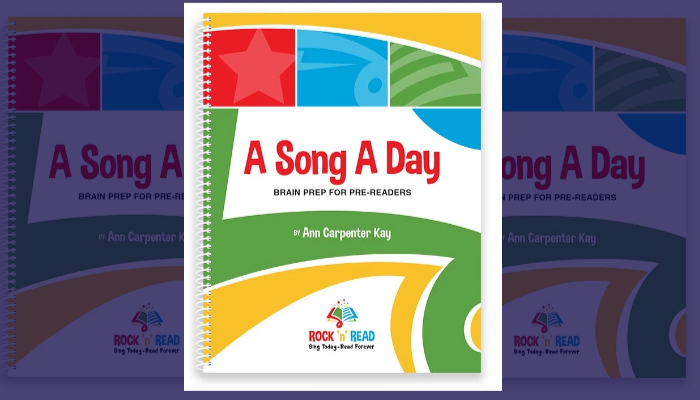
Rock n’ Read presents:
A Song a Day – Brain Prep for Pre-Readers – 15 minutes per day
By Ann Carpenter Kay
https://www.rocknreadproject.org/song-a-day-1 — See explanatory video
Published by Ventris Learning, LLC
120 pages, 8.5 x 11, soft spiral bound
Online downloads include manipulatives to print and cut out and Real Metronome or iPhone metronome are necessary.
Rhyme adds structure to language. It creates a predictable pattern that the brain can latch onto. When combined with rhythm, this pattern becomes even more powerful, activating multiple areas of the brain at once. Recent science findings show that combining music with learning enhances learning and brain function in general.
Reviewed by Michael Leppert
A Song a Day program is a novel and very usable approach to the relationship between musical practices and reading/speaking skills. The first section of the 120-page book consists of a Musical Skills Assessment that the child completes before beginning to apply his/her skills to the 50-lessons of 15 minutes per day.
The Assessment measures ability to keep a steady beat, clapping the rhythm of a song – every syllable of the lyrics – matching a pitch and singing in tune. While the last 2 skills might be biologically selective – those children with perfect pitch will ace that portion of the Assessment – children with normal levels of pitch recognition will be able to perform these 2 measurably well. The teaching adult does not need any prior musical knowledge or skill. The book provides clear guidance for each step. Studies have shown that individuals with ADHD have difficulty with some of the skills addressed in A Song a Day.
The book continues to list the Neurological Development value measurements, including the pre-Phonics skills of matching letters with the sounds they make. Also, Foundational Pre-Reading Skills value measurements are listed, so the user parent can ascertain exercise and procedures that improve the child’s ability to ultimately read and comprehend what is read.
The parent guides the child through the fifty 15-minute daily lessons and the child’s skill increases in both musical and memorization functions. Some of the songs are simple and well-known “Hush, Little Baby, Don’t Say a Word” is one; “Old McDonald Had a Farm” is another. This is excellent brain development in memorization that will last the child’s lifetime. Remember, this is for Pre-K and K age students. The imaginative musical parent can build upon the Song a Day skill developments to repeat the same techniques with more challenging musical and/or memorization exercises for older children. In other words, this teaching technique never ends. The use of the metronome at this young age will prove very valuable to the child in developing beat memory for later applications if s/he chooses to learn an instrument and/or become a serious vocalist. Developing precise rhythmic ability is absolutely necessary to sight-reading for instruments and voice.
The website, A Song a Day is attractive https://www.rocknreadproject.org/song-a-day-1
The human brain is highly responsive to rhythm and repetition.
Think about how easily children memorize nursery rhymes. Lines that might otherwise be forgettable become unforgettable when set to rhythm and rhyme. This isn’t just helpful—it’s transformative. It allows children to internalize language patterns long before they are able to read independently.
One of the most overlooked benefits of rhyming is the confidence it builds in young learners.
Reading can be intimidating. Faced with a page full of unfamiliar words, a child may feel unsure and hesitant. Rhyming changes that experience by giving children the ability to predict.
- When a child hears or reads, “We’ll catch a little fox and put him in a ____.”s/he can often guess the next word before seeing it. This sense of anticipation turns reading into an interactive experience, rather than a passive one.
Bringing It All Together
When we step back and look at the science, the conclusion is clear: Rhyming is not just a fun addition to early education — it is a foundational tool. It strengthens phonological awareness, supports memory and retention, builds confidence, enhances language development, and makes learning enjoyable. It transforms reading from a daunting task into an accessible and even joyful experience. For parents and educators, this means that incorporating rhyme into daily learning is not option l — it is essential. Ω

