
https://www.cognitivecardgames.com/
By Michael Leppert
To begin this article, it is important to remind the reader of recent findings about the value of learning with games and/or play, vs. rote memorization. Playing bean-bag catch regularly, while reciting multiplication tables is an effective, powerful mode to enable a kinesthetic learner to master the tables for life. Cognitive Card Games recognizes these findings into the brain’s nature vis a vis learning.
Cognitive Card Games is an online platform and physical card deck, dedicated to educational card games built around math and cognitive skill development — primarily through a flagship patented product called X-Squared. According to the site, the company’s mission is to “Advance the state of mathematics comprehension throughout the world” by creating tools that help players think more deeply about math, rather than simply memorizing facts.
At its core, the site aims to blend education and game design, transforming traditional math learning into interactive card-based challenges that can be played individually or cooperatively. It also suggests future expansions beyond math.
Company Mission & Educational Philosophy
The Cognitive Card Games mission page is clear about its educational intent:
-
- The founders want to “transform how the fundamentals of mathematics are learned, understood and practiced.”
- They emphasize learning by doing, asking questions, and thinking critically, reflecting quotes attributed to Einstein and Feynman about learning beyond rote memorization.
Mathematics is often taught as a set of rules and procedures rather than as a playful problem-solving process. If a card game can build intuition for order of operations, arithmetic fluency, and algebraic thinking, that seems to offer tangible benefits for learners who struggle with abstract instruction.
Flagship Product: X-Squared Math Card Deck (patent 12525142)
Core Concept
At the heart of the website is X-Squared, billed as a math brain game built around PEMDAS/order of operations (Parentheses, Exponents, Multiplication and Division, Addition and Subtraction). You use Integer (whole number) cards, Operation cards, and other functional cards to craft equations that match a given Solution card.
X-Squared is the first publicly available Order of Operations game that includes two critical elements: 1) Complete and 2) Simple. These attributes make this product universally applicable.
It is complete in that it physically contains all elements of PEMDAS: Parentheses, Exponents, Multiplication, Division, Addition and Subtraction. It enables game play that allows players to fully express their understanding of these concepts. There is another game on the market, called PEMDice, that includes each of the elements mentioned, but it is contrived. The play is limited.
It is simple in that the instructions can be easily understood and followed. There is one other product on the market that is structurally complete, Equations. That is a brilliant game that was created in 1962 and is still used in math competitions today for gifted students. While complete, Equations is not simple. There are numerous complex rules that constrain its accessibility.
In more detail:
-
- A basic game challenge involves using specific integer and operator cards to create an equation equal to a target number.
- Parentheses and exponent cards can optionally be used to expand possibilities.
- The deck supports unlimited game possibilities, including formats akin to puzzle challenges or even “game show”-style play.
This format resembles classic educational card games like Krypto — a math card game where players create valid expressions to reach a target number — but Cognitive has more structured rules and the Cognitive custom cards, rather than standard playing cards.
Deck Contents & Structure
X-Squared decks contain a large set of cards:
-
- Integer cards (whole numbers)
- Operation cards (+, −, ×, ÷)
- Parentheses cards
- Exponents and solution cards
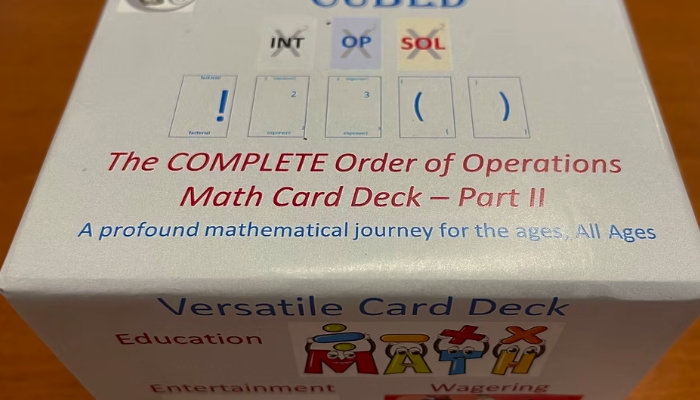
A companion product (X-Cubed), to be released in 2027, includes additional mathematical functions like factorials.
This structure gives the game a modular and customizable quality — users can adapt difficulty or introduce optional rules, adding to its long-range value.
Gameplay & App Integrations
The site also offers digital versions and tools to support gameplay:
-
- A Daily Challenge section presents math challenges based on the X-Squared logic, which players can solve against archived problems.
- A digital App called X-Squared Challenge aims to let players practice these puzzles on web or mobile. A Beta version is currently available to the public for free at:
https://x-squared-challenge-basic-classic.base44.app
Games for All Ages?
The site states that the games are “for all ages” — from young learners, getting comfortable with arithmetic, to adults looking for brain training.
This wide range is appealing. Math puzzles can be intellectually stimulating and fun, especially when presented clearly. It is up to the parent or teacher to determine the level of math familiarity of his/her child.
Pricing & Purchasing
Cognitive Card Games currently sells two products:
-
- X-Squared Math Card Deck — ~$18.18
- X-Squared Challenge Digital App— ~$11.11
App available for download through the App Store and Google Play on April 1, 2026.
These prices are competitive with many specialty card games and educational tools.
Similar products associated with the X-Cubed Math Card Deck will be available in 2027.
Strengths
- Educational Focus
There’s real value in games that encourage conceptual understanding over memorization — especially in subjects like math, where many students struggle with abstraction. X-Squared’s mechanics, building expressions to match targets, likely do reinforce operational thinking and fluency with arithmetic concepts.
Card games and puzzles have been linked to cognitive benefits such as improved working memory, pattern recognition, and executive functioning.
- Flexible Gameplay
Because the deck supports unlimited possibilities and multiple game modes (basic play, challenges, game show style), the user experience potentially remains fresh longer than with rigid board or puzzle games.
- Cross-Platform Support
Offering both physical decks and digital challenges expands accessibility for different types of learners. Physical decks are appropriate in a classroom setting, apps more for individual practice.
- Broad Accessibility
Claiming “all ages” suggests broad accessibility, but math card games that require PEMDAS mastery may be challenging for younger children unless significant scaffolding is provided. The product is accessible to young learners simply through its content. While the embedded structure enables a full exploration of PEMDAS, it requires no knowledge of PEMDAS to use. Children between ages 3-7 can simply lay out the cards in front of them and manipulate them in a free form interaction. For instance, they can count using the integer cards 0-9. They can practice basic operations by putting an Addition card between two integer cards. The cards themselves may be used in any manner imaginable. This has been demonstrated already, by setting an X-Squared deck in front of a group a young children. They responded by naturally placing cards in various configurations to practice counting and basic math operations.
Games with Cognitive Value
Card games have long been used to build cognitive skills:
-
- Classic memory games help focus and recall.
- Number puzzles like Krypto help arithmetic fluency.
- Strategic card games stimulate planning and decision-making.
In educational contexts, card decks are often used to reduce anxiety around learning and make abstract concepts more tangible.
Who Cognitive Card Games Is Best For
This product is best suited for:
-
- Math enthusiasts who enjoy puzzles and numerical challenges.
- Educators looking for creative classroom tools.
- Parents seeking a tactile, non-screen alternative to apps for practicing arithmetic.
- Older students or adults who want playful drill on order of operations.
Finally
Cognitive Card Games — particularly through X-Squared — presents an innovative and appealing concept: A card deck that turns mathematical operations into interactive challenges. The research-supported notion that engaging with puzzles builds cognitive skills aligns with broader findings on the benefits of card games.
Overall, Cognitive Card Games is a clever concept with real potential, especially for those who enjoy math and card-based challenges. Considering its value and price, this is a game worth keeping and using for many years at home or in the classroom! Ω

